Why Your Business Isn't Showing Up in Search (And What to Do About It)
A practical guide to local SEO for business owners. Learn why specificity beats scale and how to actually show up in search for the communities you serve.

There's a moment every local business owner knows well. You Google your own business, hoping to see it near the top of the results, and instead you find a competitor two towns over. Or nothing at all. The work you do is good. The customers who find you tend to stay. The problem is the finding.
That gap between the quality of your business and your visibility in search results is exactly what local SEO is designed to close. And for businesses operating in specific communities, be it a single county, a cluster of small towns, or a defined service area, there are some simple tips to help you improve.
Here's what that looks like in practice, why it works, and how to start.
The Difference Between Local SEO and Hyper-Local SEO
Most small business owners have heard the phrase "local SEO" by now. It generally means optimizing your online presence so that people searching in your city or region can find you. That's useful. But it's also increasingly crowded.
Hyper-local SEO takes the same principles and applies them to a smaller, more specific geography: your neighborhood, your county, the towns you actually serve. A search for "solar installer near me" while standing in Arcata, California is a fundamentally different query than a search for "solar installer in Northern California" — and Google knows it.
The person doing a hyper-local search is usually ready to act. They're not browsing. They have a need, they're in your service area, and they're asking Google who can help. The businesses that show up are the ones that have done the work to tell Google, clearly and repeatedly, exactly where they operate and who they serve.
Start With Your Google Business Profile
Before anything else, your Google Business Profile needs to be complete, accurate, and actively maintained. This is the single most important element of local search visibility — the listing that appears in Google Maps, in the local "map pack" at the top of search results, and in voice search responses.

The basics matter more than most people realize. According to Google's own research, businesses with complete listings are twice as likely to earn customer trust and significantly more likely to see in-store visits and purchases. Your name, address, and phone number need to match exactly across every platform where your business appears — your website, Yelp, Facebook, industry directories, and anywhere else. Google uses these consistent citations to verify that your business is legitimate and trustworthy. Inconsistencies create doubt, and doubt hurts rankings.
Beyond the basics: post updates regularly, respond to every review, answer questions in the Q&A section, and add photos that reflect your actual business. A dormant profile, even a complete one, tells a quieter story.
Think Smaller Than Your City
Here's where most local SEO advice stops short. Filling out your Google Business Profile is necessary, but for businesses in smaller markets, it's rarely sufficient. The real leverage comes from building content and signals around the specific geography you serve.
Hyper-local keywords are more specific than city-level terms — they include the names of neighborhoods, nearby towns, and local landmarks. If you're a contractor serving a four-county region, a page titled "Solar Installation in Fortuna, CA" will outperform a generic "Northern California Solar" page almost every time, because the competition for the narrower term is lower and the searcher's intent is clearer.
Rather than listing service towns in a footer paragraph, effective hyper-local SEO means building individual pages for each area you serve. These pages shouldn't be thin or interchangeable. Each one should address the specific community: who you've served there, what makes your service relevant to that area, and why the trip is worth it. Local landmarks, street names, and community references all send meaningful signals to Google about where your business actually operates.
A Real Example: Six Rivers Solar in Humboldt County
This isn't theoretical. Six Rivers Solar, based in Humboldt County, California, came to us with a common problem: a strong local reputation, a quality product, and virtually no organic search visibility. They were well-known to the customers they'd already served, but largely invisible to the people who didn't yet know they existed.
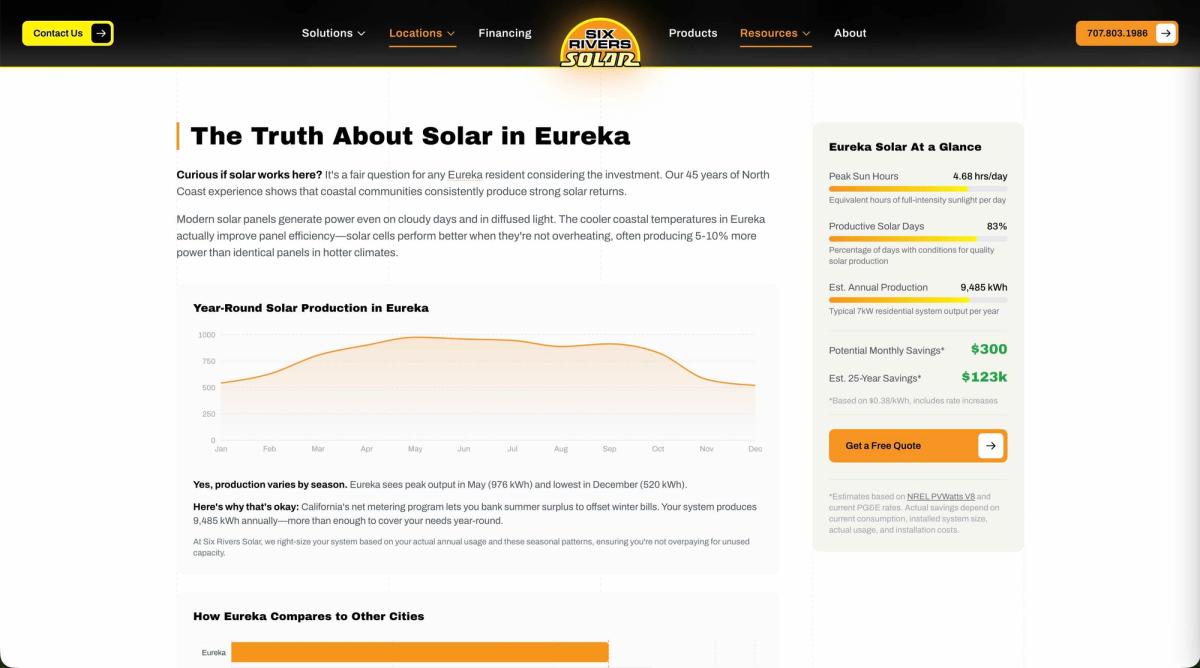
The solution wasn't a complete overhaul. It was focused hyper-local work: optimizing their Google Business Profile with accurate information and consistent NAP citations, building individual location pages for the specific communities they serve throughout Humboldt County — towns like Eureka, Arcata, Fortuna, and McKinleyville — incorporating local geographic language naturally into their website content. We even included real-world data and statistics on every location page, helping users understand the impact of solar in their specific region while signaling authority to the search platforms that matter.
The result was a 400% increase in organic search traffic. Not from national campaigns or paid ads, but from becoming the most visible solar installer for the people who were actually searching for solar installation in their specific corner of Northern California.
What made the difference was specificity. Humboldt County is geographically distinct, relatively isolated from major metro areas, and underserved by the kind of SEO investment that saturates urban markets. A targeted hyper-local strategy found an audience that was already looking and made sure Six Rivers Solar was the answer they found.
Build Local Content, Not Just Local Keywords
Keywords get you found. Content keeps people on your site and builds the kind of authority that search engines reward over time.
Writing about your community — local service guides, posts on regional policy changes relevant to your industry, content tied to local events — establishes your business as a genuine local authority. A solar company that writes about Humboldt County's net metering policies, or the specific roof types common to older homes in Eureka, is providing genuine value to local searchers. That value gets noticed.
Local links matter too, and you don't need coverage from major publications to earn them. Mentions from community websites, local news outlets, regional blogs, and industry directories all contribute to your local authority. Sponsoring a local event, joining the Chamber of Commerce, or getting cited in a local news story are forms of link building that also happen to be good community citizenship. As BrightLocal's research shows, backlinks from locally relevant websites carry real weight precisely because they're harder to manufacture than generic directory listings.
Reviews Are Part of Your SEO Strategy
Most business owners think of reviews as a customer service concern. They're also a significant ranking factor. Google considers both the quantity and quality of reviews when determining local rankings, and Moz's annual local ranking factors survey consistently places reviews among the top signals influencing where businesses appear in local results.
The practical implication: make it easy for your customers to leave reviews, and ask them to do it. A follow-up email after a completed job, a QR code at your location, a simple verbal ask at the end of a transaction. Most satisfied customers are willing to help if you make the process simple. Responding to all reviews — not just the negative ones — shows Google and potential customers that you're engaged and attentive. It's a small thing that accumulates into a meaningful signal over time.

The Long Game
None of this produces results overnight. SEO is a compounding investment: the work you do today builds authority that pays off over months and years, not days. Backlinko's local SEO guide puts it plainly — businesses that show up reliably in local search aren't doing one big thing right; they're doing many small things right, continuously.
What the Six Rivers Solar example illustrates is that for businesses in smaller, well-defined markets, the competition for local search visibility is often genuinely winnable. The tools and tactics aren't complicated. What's required is sustained attention, geographic specificity, and a willingness to think about your online presence the way you think about your physical one: as something that needs to be actively maintained and clearly located.
Your customers are already searching for what you offer. The question is whether they're finding you.
Want to understand what a hyper-local SEO strategy would look like for your business? We'd be glad to take a look.
Get a Free Website AuditFollow along on Substack to receive the latest articles in your inbox