Why Your Homepage Isn't the Front Door Anymore
Your homepage used to be the front door of your website. For most small businesses, that hasn't been true for years. Google sitelinks, AI Overviews, and deep-linked search results mean that visitors can arrive at almost any page on your site first. Here's what that shift looks like, why it matters, and how to make every page on your website work as a landing page.
We have a saying at Mithril Media that every page on your website is a landing page. It's something close to a mantra for us, and it shapes every design and build we take on. The idea is simple. People are no longer likely to arrive at only your homepage, which means your homepage is no longer guaranteed to be the first impression someone has of your business.
That changes how we think about design. It changes how we build. And for most small business owners, it should change how you look at the website you already have.
How We Got Here
For a long time, the homepage really was the front door. And more specifically, it was the only door. People arrived at your website by typing your URL into a browser, or by clicking a single link in a Google search result that took them directly to your main page. That was their first impression, and as a designer or business owner, you could rely on it.
From a design perspective, this meant you could pour most of your attention into your homepage and feel pretty confident that visitors would experience your business the way you intended.
That dynamic has shifted in some meaningful ways over the past few years.
Google Got Smarter
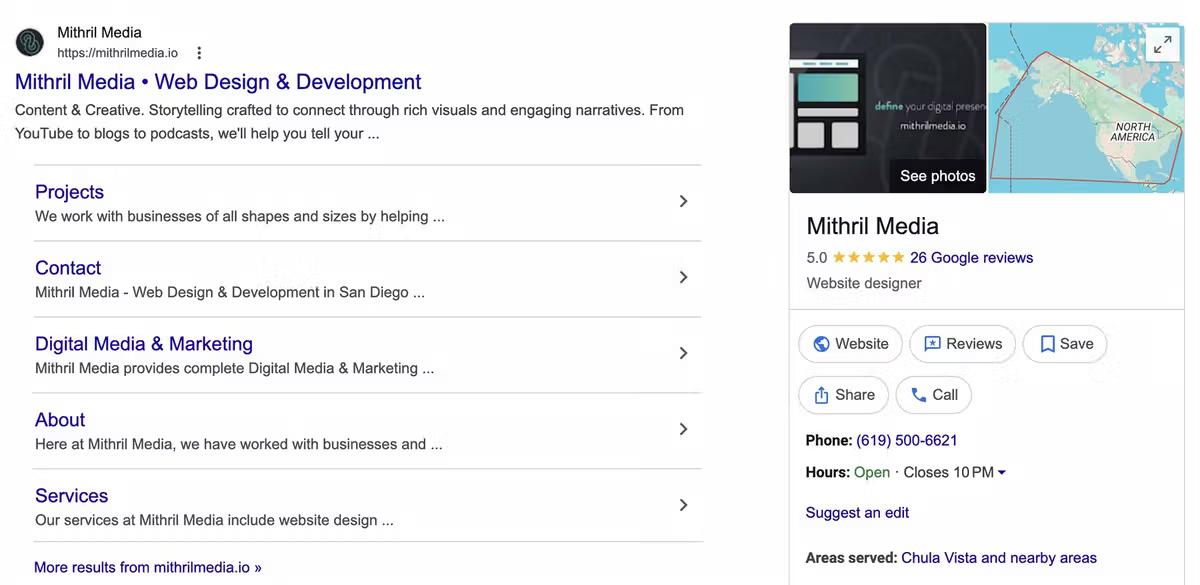
The first shift came from Google itself. When you search for a business today, you don't just see a single link. You see a primary result, and underneath it, a set of smaller links pointing to specific pages within that website. An About page, a Services page, a Contact page. Google calls these sitelinks, and they're chosen automatically based on what Google thinks is most useful for the person searching.
What that means in practice is that somebody can click any one of those links and arrive at your website for the first time on a page that isn't your homepage. Your About page, your Services page, or your Contact page might very well be the first thing someone sees when they encounter your business online.
AI Entered the Picture
The second shift, and the bigger one, is AI. Google now shows AI Overviews on just about every search. These summaries pull from sources across the web and link directly to specific pages.
A study by Ahrefs looked at over 860,000 search queries and found that only 38 percent of the pages cited in Google AI Overviews also ranked in the top ten organic results. The rest came from pages buried much deeper, or pages that didn't appear in the traditional results at all.
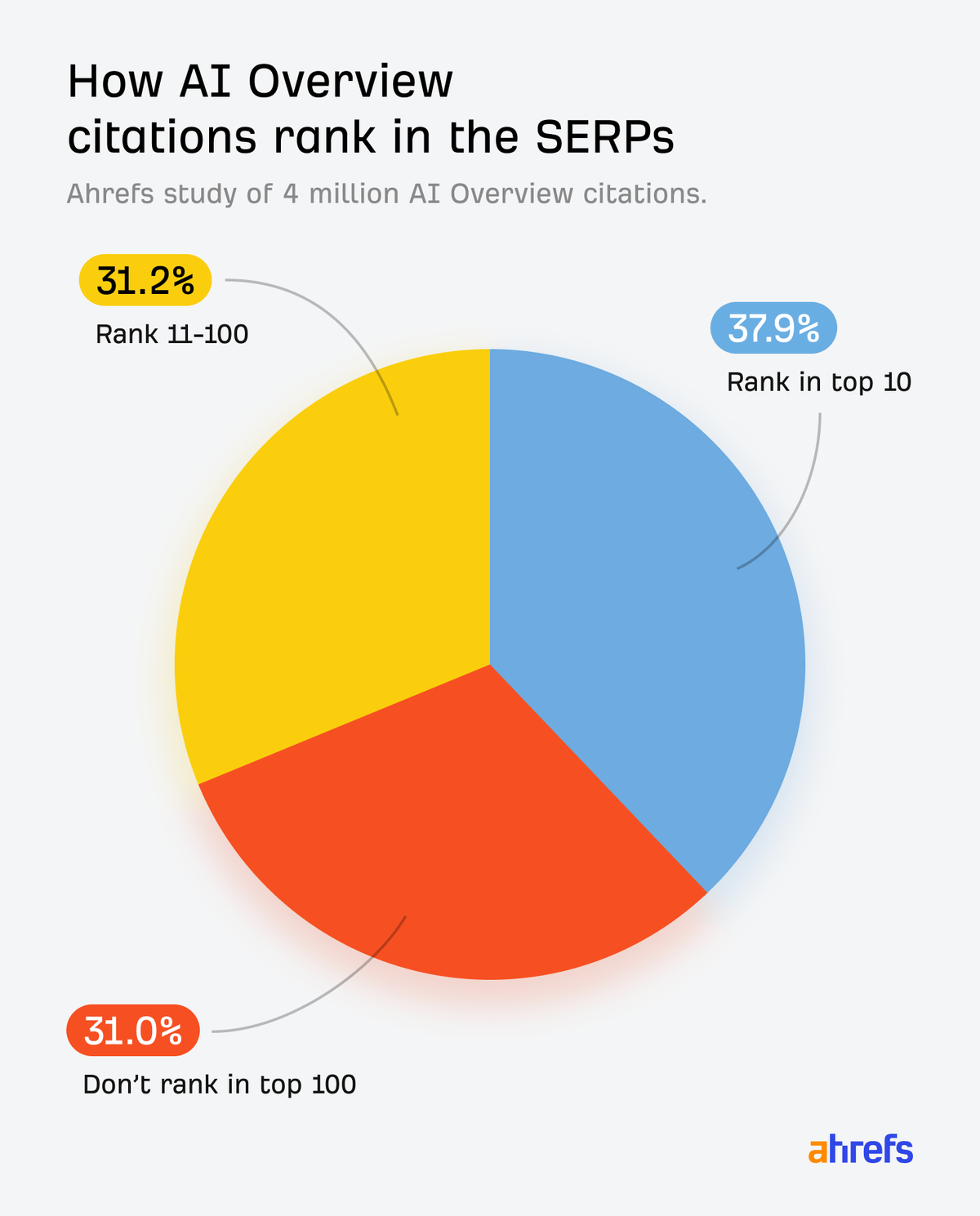
That's a significant number. It means the lion's share of content being surfaced in AI search overviews is coming from somewhere other than the websites occupying the top spots on Google. In some ways, that's a leveling of the playing field. It gives smaller sites a real chance to have their content surfaced higher. But it also speaks directly to why every page on your site needs to be ready to receive visitors, because there's a much higher likelihood that someone will click a link and land on a page you didn't think of as a landing page.
Chatbots Are Another Door
Take the AI use case one step further. Think about how people interact with chatbots like ChatGPT and Claude. They ask questions directly in the chat interface, and those tools respond with answers that increasingly include citations and links to external sources.
The questions people ask chatbots are usually deep questions, the kind that aren't going to be answered on your homepage. They're answered in blog posts, FAQ pages, or detailed service descriptions. If those pages are being cited by a chatbot, that's another way a visitor could see your website for the first time.
So when we zoom out and look at the full picture, yes, your homepage is still the front door. But what we're seeing is that a lot of side doors have opened. A few windows have been left cracked. Users have more ways than ever to enter your site, and most of those entry points aren't the place you spent the most time designing.
What This Looks Like in Practice
To show you what it means to treat every page as a landing page, I want to walk through a project we built recently for the HNRNP Family Foundation.
The HNRNP Family Foundation is a nonprofit organization with two very different primary audiences. On one hand, they support families who have recently received a diagnosis of a rare HNRNP-related neurodevelopmental disorder. On the other hand, they serve the global scientific community through research funding, grants, and published papers.
Those are two completely different groups of people, with different needs, different vocabularies, and different reasons for visiting the website. And the way they arrive at the site is going to be different too. They're searching for different things, and they're going to land on different pages.
The Newly Diagnosed Family
Imagine you're a parent, and you just learned your child has been diagnosed with a rare genetic condition you've never heard of. Your first move, almost certainly, is to go to Google. You're searching, researching, and trying to understand what this diagnosis means for your family.
If you land on the Newly Diagnosed page of the HNRNP Family Foundation website, that page needs to do a lot of work very quickly. It needs to orient you. It needs to feel trustworthy. It needs to give you the information you were searching for while also making clear that this organization is a community you can lean on. And it needs to show you what to do next.
That's a lot to ask of a single page. But that's exactly what this page needs to deliver, because for that parent, it's the entire first impression of the foundation.
The Researcher
Now flip to the other side. Picture yourself as a researcher actively looking for grant opportunities to study rare genetic conditions. When you arrive at the HNRNP Family Foundation website, you're almost certainly going to arrive at the Science and Research section, not the Newly Diagnosed page.
Your needs are completely different. You're looking for credibility, for data, for information about the registry and active research initiatives. But the page still has to orient you, still has to feel trustworthy, still has to show you what to do next.
Same website. Two entirely different first impressions. Both need to stand on their own.
Start With the User
Understanding why people are arriving at your website, and what they're trying to accomplish when they get there, is step number one. You really have to understand your user in order to see why treating every page as a landing page matters so much. Everything that follows flows from that.
The Four Things Every Page Needs
So how do you think about this in terms of your own website? I'd break it down into four things to keep in mind for every important page.
1. Every Page Needs Context
A visitor should be able to figure out who you are, what you do, and where they are on your site without any second-guessing. Quickly and easily, the moment they arrive.
This means your branding, your navigation, and the copy you use all need to accurately reflect what you're trying to convey. Maintaining a consistent layout and a clear content hierarchy across your site is the easiest way to pull this off. A design system helps. A user-first mindset helps more. When you approach your site this way, you end up with organized, easy-to-understand information, and context becomes something visitors can grasp in seconds.
2. Every Page Needs a Next Step
Every marketer will tell you how important a call to action is. Let's be more deliberate about it. If somebody lands on your About page, what do you actually want them to do next? And more importantly, what do they want to do? Why did they arrive there in the first place, and what's the next piece of information they're trying to find?
Giving your visitor a clear path forward is one of the best things you can do to make sure every page on your site functions as a landing page. If a page dead-ends, you're losing people.
3. Every Page Needs to Be Performant
This one is probably the most overlooked and, in my opinion, the most important of the four. Too often, we optimize the homepage for great page experience scores and leave the rest of the site untouched. Once you accept that the homepage isn't always the first thing people see, you understand why every other page deserves the same level of attention.
What do we mean by performance? Pages should load quickly. They shouldn't shift and jump around as content appears. They should look great on mobile. These things matter for human visitors, because a slow or janky page sends them right back to the search results. And they matter for Google, because page experience is a direct factor in how your site gets ranked. The lower your pages score on those thresholds, the less likely they are to be returned as a result in the first place.
4. Every Page Needs to Earn Trust
Trust signals are a critical part of any website strategy. Whether that's testimonials, logos from organizations you've worked with, awards, certifications, or any other form of social proof, these elements are essential. Especially when you know that someone is arriving at this page for the very first time and doesn't yet know who you are or what you do.
Sprinkle trust signals throughout your site. An easy way to make sure they always appear is to include them in your footer, or even your header, depending on your layout. That way, no matter which page a visitor lands on, they can access those trust signals with ease.
Your Homework
Here's some low-hanging fruit you can tackle this week. Take a look at some of the secondary pages on your website. How well do they tell your story? Do they give enough context? Are they fast and mobile-friendly? Are trust signals visible? Is there a clear path forward?
A good litmus test is to start on a secondary page and put yourself in the end user's shoes. Look at your website through the eyes of someone arriving there for the very first time. How easy is it to accomplish what they came for? How quickly does the page load on your phone? Does the experience hold up across both mobile and desktop?
The lion's share of web traffic today comes from mobile devices, so the mobile experience matters more than the desktop one in most cases. Don't skip it.
If you want to see the "every page is a landing page" mindset in practice, take a look at hnrnp.org. It's a live example of what this approach looks like when it's applied consistently across a website with very different audiences and very different entry points.
The Shift You Need to Make
The homepage used to be the only entry point into your website. That's no longer the case. Shifting your mindset and seeing your website the way visitors actually experience it, as a collection of potential first impressions rather than one front door, will help your site perform better in every measurable way. It will also make your site feel more useful and more human to the people who find you, which is ultimately the point.
If your homepage is the only page you've really optimized, you're leaving most of your website's potential on the table. We can help you audit every important page and build a site where every entry point earns trust.
Get a Free Website AuditFollow along on Substack to receive the latest articles in your inbox